










What Is Online Blackjack?
It is a digital casino card game in which you play against the dealer rather than other players. The usual objective is to win with a higher valid total than the dealer without exceeding 21, or by avoiding a bust when the dealer goes over 21. It is one of the table games covered in our online casino guide.
A natural blackjack consists of an ace and a ten-value card dealt as the first two cards. Reaching 21 with three or more cards is not a natural blackjack, and its priority or payout may differ. Online blackjack can use a random number generator (RNG) to deal virtual cards or physical cards dealt by a live dealer over video.
How Does A Blackjack Hand Work?
In standard blackjack, you and the dealer receive separate hands. After any initial check for dealer blackjack required by the table rules, you make the permitted decisions first. The dealer then completes their hand according to fixed drawing rules. The main bet can produce these outcomes:
- You win when your valid total is higher than the dealer’s.
- You win when the dealer goes over 21 and your hand has not busted.
- You lose the main bet immediately when your hand goes over 21.
- Equal valid totals normally produce a push, which returns your main stake.
- A natural blackjack beats a non-natural 21. Matching natural blackjacks normally produce a push.
The table rules determine exactly how a natural blackjack is treated and paid. Numbered cards use their face values, while jacks, queens and kings count as 10. An ace counts as 11 when doing so produces a valid higher total; otherwise, it counts as 1.
A hard hand has no ace currently counted as 11. A soft hand has at least one ace counted as 11 without taking the total over 21. A pair contains two cards of the same rank, although the table rules determine which hands can be split.
What Can You Do With Your Blackjack Hand?
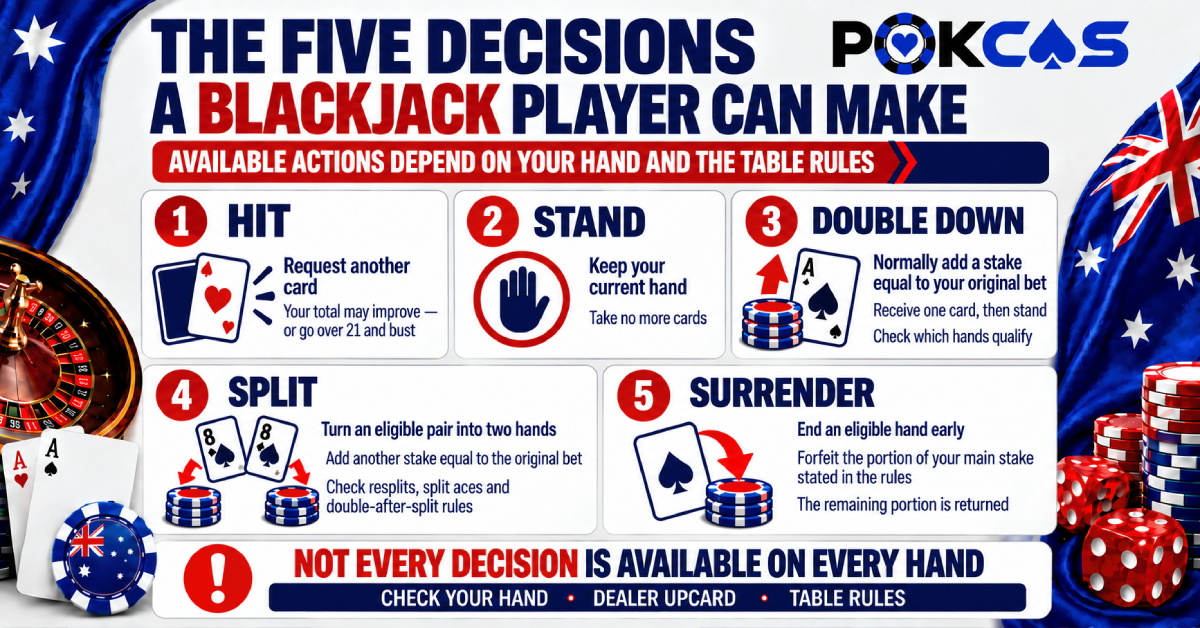
The five hand-playing decisions covered here are hit, stand, double down, split and surrender. The actions available depend on your hand and the table rules, so not every decision will be offered at every stage.
Hit Or Stand
To hit is to request another card. This can improve your total or take it over 21, causing a bust. To stand is to keep your current hand and take no more cards.
The appropriate decision depends on your hand, the dealer’s upcard and the applicable rules.
Double Down
Doubling down normally means adding a stake equal to your original main bet. Under standard rules, you then receive one additional card and must stand.
Some tables allow doubling only on specified two-card totals. The rules also determine whether you can double after splitting.
Split A Pair
Splitting turns an eligible pair into two separate hands. You must place another stake equal to your original main bet, and each hand is then played separately.
The table rules determine which two-card combinations qualify for a split, how many times you can split, whether aces can be resplit and whether you can double after splitting. Split aces may also be limited to one additional card each.
Surrender
Surrender allows you to end an eligible hand by forfeiting the portion of your main stake specified in the rules. The remaining portion is returned to you.
Surrender is not available at every table. Its timing, eligible hands and returned amount must be checked in the reviewed game’s rules.
Blackjack Rules That Can Cost You More
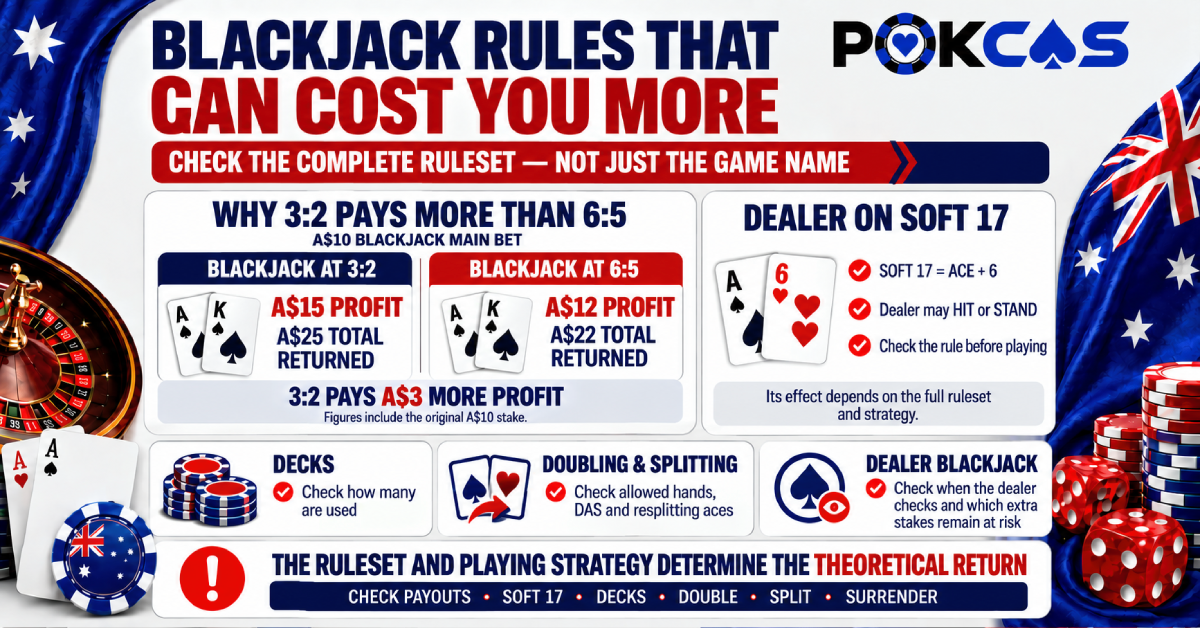
Two games carrying the blackjack name can use different payouts and playing conditions. Before choosing a table, check the complete rules rather than relying on the game’s title or appearance. The ruleset and the playing strategy assumed in the calculation together determine its theoretical return.
Why 3:2 Pays More Than 6:5
Payout notation shows the profit awarded relative to the stake. A 3:2 payout provides A$3 in profit for every A$2 staked, while 6:5 provides A$6 for every A$5.
The figures below assume that the original A$10 stake is returned in addition to the listed profit.
| Outcome on an A$10 main bet | Profit | Total returned |
|---|---|---|
| Ordinary win at 1:1 | A$10 | A$20 |
| Blackjack at 3:2 | A$15 | A$25 |
| Blackjack at 6:5 | A$12 | A$22 |
| Push | A$0 | A$10 |
The advertised blackjack payout applies to a winning qualifying two-card natural unless the game rules state otherwise.
Check the natural-blackjack payout before joining a table. On an A$10 stake, 3:2 pays A$3 more profit than 6:5 for the same winning blackjack.
Dealer Hits Or Stands On Soft 17
A soft 17 is a hand totalling 17 with an ace counted as 11, such as an ace and a six. At some tables, the dealer must stand and take no more cards on soft 17. At others, the dealer must hit and draw another card.
Pokcas states which condition applies to every reviewed game. Its effect on the theoretical return should not be assigned a universal figure because the calculation also depends on the remaining table rules and the strategy assumed.
Decks, Doubling And Splitting Restrictions
The main conditions to check before playing are:
- The number of decks
- The hands on which doubling is permitted
- Whether doubling after a split is allowed
- Whether aces can be resplit
- The maximum number of hands that can be created
- Whether surrender is available
- How and when the dealer checks for blackjack
- Which stakes are lost if the dealer reveals blackjack after you act
These conditions can change the decisions available to you and the game’s expected return. The number of decks changes card probabilities. The dealer’s blackjack procedure and the associated loss rule determine whether additional split and double stakes remain at risk when blackjack is revealed after you act. Because the rules interact, Pokcas does not attach a universal house-edge figure to one condition viewed in isolation.
What Blackjack RTP And House Edge Really Mean
Return to player, or RTP, is the theoretical percentage of the total amount wagered that a game is expected to return as winnings over the long run under defined rules and assumptions. The house edge expresses the casino’s corresponding average mathematical advantage. When both figures are calculated on the same basis, the house edge equals 100% minus the RTP.
Neither figure predicts the outcome of one hand or playing session. The house edge is not the exact percentage of a player’s deposit or balance that will be lost.
Why The Published RTP May Assume Basic Strategy
A player’s decisions can affect blackjack’s expected return. A published RTP may assume basic strategy: the set of mathematically preferred decisions for the player’s hand, the dealer’s visible card and the specified table rules.
Different decisions may produce a different expected return. Before publishing an RTP, Pokcas checks whether the provider identifies the playing method, rules and other assumptions used in its calculation. A theoretical maximum RTP should not be presented as the result every player will receive.
Why One Session Will Not Match The RTP
RTP is a long-run expectation based on a large volume of resolved bets. Actual results vary, so a short session’s percentage return may be above or below the published figure.
The house edge represents an average mathematical advantage based on the amount wagered under the stated conditions, not a fixed deduction from every bet. Playing for longer does not guarantee that an individual player’s percentage return will match the published RTP, nor does the game compensate for earlier wins or losses.
Should You Take Insurance Or Play Side Bets?
The main blackjack wager is settled by comparing your hand with the dealer’s under the table rules. Insurance, Perfect Pairs, 21+3 and similar options are additional wagers with their own stakes, qualifying outcomes, paytables and mathematical returns. Placing one increases the total amount risked during the round.
Whether an optional wager is suitable depends on its individual rules and maths. Check its stake, winning conditions, payout and published RTP or house edge rather than applying the main blackjack game’s RTP to it.
How Insurance Works
Insurance may be offered when the dealer’s visible card is an ace. It is a separate wager on whether the dealer will have a natural blackjack and is settled separately from the main wager.
Check the individual game rules for the permitted insurance stake, payout and settlement timing. Insurance responds only to a dealer blackjack. A player bust or an ordinary dealer win does not, by itself, make the insurance wager win.
Even Money On A Blackjack
Some tables may offer even money when the player has a natural blackjack and the dealer’s visible card is an ace. If accepted, the player receives the even-money profit specified by the table regardless of whether the dealer also has blackjack.
Where a verified table pays 3:2 for a natural blackjack, permits insurance equal to half the main stake and pays insurance at 2:1, accepting even money and taking the maximum insurance wager produce the same net profit. Under those conditions, that profit equals the original main stake. If any of these rules differ, the relationship must be recalculated. Even money should not be treated as automatically beneficial.
Perfect Pairs, 21+3 And Other Side Bets
Perfect Pairs generally pays when the player’s first two cards form a qualifying pair. A 21+3 wager generally combines the player’s first two cards with the dealer’s visible card to form specified poker-style combinations. These bets are settled separately from the main blackjack wager, even though they use cards from the same deal.
Before placing a side bet, check:
- Required stake: The permitted amount and any relationship to the main wager.
- Winning combinations: The exact card combinations that qualify.
- Paytable: The profit awarded for each winning result.
- Published RTP or house edge: Any return figure provided for that wager and paytable.
- Maximum payout: Any limit placed on the amount awarded.
- Settlement rules: When the bet is decided and how overlapping winning combinations are treated.
Perfect Pairs, 21+3 and other side bets should not be combined under one probability, RTP or house-edge figure. Each must be assessed using its own rules and paytable.
Does Basic Strategy Improve Your Decisions?
Yes. Basic strategy can improve your decisions by identifying a mathematically preferred action for each hand under a defined set of table rules. Following a matching strategy chart can reduce the expected disadvantage caused by avoidable playing errors.
It cannot control the next card, remove a house edge built into the table rules or guarantee a profit from any hand or session.
Reading A Strategy Chart
A basic strategy chart matches the player’s hand with the dealer’s visible card. Find your hand in the relevant row and the dealer’s card in the corresponding column. Their intersection shows the recommended action, such as hit, stand, double, split or surrender where available.
Charts normally separate hard hands, soft hands and pairs. An ace valued as 11 changes the risk of going over 21, while a pair may provide the option to split. Check the chart’s legend carefully, as it should explain what to do when an option such as doubling or surrender is unavailable.
Why The Table Rules Change The Correct Move
A strategy chart must match the rules of the table being played. Confirm:
- Number of decks: The chart must cover the stated deck configuration.
- Dealer action on soft 17: Check whether the dealer hits or stands.
- Doubling rules: Confirm which hands can be doubled and whether doubling after splitting is permitted.
- Splitting rules: Check resplitting limits and any special treatment of split aces.
- Surrender options: Confirm whether surrender is offered and when it can be used.
These conditions affect the available actions and their expected mathematical results. A recommendation produced for one ruleset may therefore be incorrect for another. No strategy chart should be presented as universally applicable, and any complete chart must be mathematically verified against the exact rules it claims to cover.
What Basic Strategy Cannot Do
Basic strategy does not predict which card will appear next, prevent a sequence of losses or make every session profitable. It improves the mathematical quality of playing decisions without controlling the cards dealt.
A betting progression changes the size and order of the stakes. Changing the stake alone does not make the next card or hand more favourable; it changes the amount of money at risk.
Card counting is different from basic strategy because it attempts to use changes in the cards remaining in a shoe. If an RNG game reshuffles after every hand, information from earlier hands cannot be used to assess a remaining shoe. RNG shuffle procedures vary by game. A live table using a physical shoe may deal several rounds before shuffling, but its dealing and shuffle procedures must still be checked.
Live Dealer, RNG And Blackjack Variants

Blackjack is available in streamed and software-based formats, as well as variants that change the cards, dealing procedure or player options. Check the rules of the individual game rather than relying on its name or presentation. Learn more about live dealer casinos.
Live Dealer Versus RNG Games
Live dealer blackjack uses physical cards dealt at a table shown through a video stream. RNG blackjack uses game software and a random number generator to determine the cards dealt through a digital interface.
| Feature | Live dealer blackjack | RNG blackjack |
|---|---|---|
| Card source | Physical cards dealt at a streamed table | Cards determined by game software using an RNG |
| Presentation | Live video stream | Digital game interface |
| Playing pace | Controlled by the table | Often controlled by the player |
| Seat availability | May be limited | Usually not limited by physical seating |
| Connection needs | Game data and video stream | Game connection |
| Evidence to check | Studio, provider and table rules | Provider, testing information and game rules |
A live stream does not automatically provide better payouts or a lower house edge. When the card probabilities, table rules and player decisions are equivalent, the presentation does not change the game’s mathematical return.
A delayed or interrupted stream may prevent the player from following the table or submitting a decision in time. The physical cards determine the result; the video feed displays the action. The applicable interruption rules determine how an accepted wager or unfinished hand is handled.
Classic, European And Atlantic City Rules
Variant names can indicate a recognisable style of blackjack, but they do not establish every rule. Providers may offer games with similar names but different decks, dealer procedures, payouts or player options.
| Game name | Common distinction | What to verify |
|---|---|---|
| Classic blackjack | Usually presented without a major branded rule change | Decks, dealer rule and natural-blackjack payout |
| European blackjack | May defer the dealer’s second card until player hands are complete | Dealer-card procedure and doubling restrictions |
| Atlantic City blackjack | Commonly associated with particular splitting and surrender rules | The complete table rules |
| Vegas Strip blackjack | Often uses a multi-deck ruleset | Dealer rule, doubling options and natural-blackjack payout |
Treat these descriptions as starting points, not guaranteed specifications. Verify the individual title’s complete rules before comparing it with another game. A reliable house-edge calculation cannot be made from the variant name alone.
Spanish 21 And Blackjack Switch
Spanish 21 normally uses 48-card decks, with the four 10-spot cards removed from each deck. Jacks, queens and kings retain a value of 10. The game may also provide special payouts and additional player options. Check the number of decks, dealer rules, available decisions and complete paytable for the specific version.
Blackjack Switch requires two main wagers and deals two hands. The player may make a one-time exchange of the second card dealt to each hand before continuing play. Check how the game treats a dealer total of 22, switched or split two-card 21s and natural blackjacks.
These variants should not be treated as interchangeable. Each has its own card composition, player options and settlement rules.
Blackjack gives players decisions such as hitting, standing, doubling and splitting after the cards are dealt. By comparison, online roulette centres on betting on a wheel outcome, while online baccarat normally asks the player to back the Player hand, Banker hand or Tie rather than decide how the cards are drawn.
How To Play Your First Blackjack Hand Online
The controls vary between games, but a conventional blackjack hand usually follows the sequence below. Apply the rules displayed at the table at every step.
Read The Table Rules
Check the natural-blackjack payout, whether the dealer hits or stands on soft 17, the available player decisions and the minimum and maximum bets. Confirm these conditions before committing a stake.
Place The Main Bet
Choose the amount to stake and confirm it before the game closes betting and deals the first card. Any side bet selected before the deal, and any insurance offered afterwards, is a separate wager that increases the total amount risked.
Read Your Cards And The Dealer’s Upcard
Calculate your total and check the dealer’s visible card. Identify whether your hand is hard, soft, paired or already a natural blackjack.
Choose An Available Action
If the round remains active and your hand requires a decision, select hit, stand, double down, split or surrender as permitted. The available options depend on your cards and the table rules.
Complete Any Split Hands
This step applies only when you split an eligible pair. The resulting hands are played and settled separately, although the table rules may restrict the decisions available on either hand.
Watch The Dealer Complete The Hand
If at least one wager still depends on the dealer’s result, the dealer draws or stands according to the table’s fixed rules. The completed dealer hand is then compared with each unresolved player hand.
Check The Payout
Confirm whether the main wager won, lost, pushed or was settled under a surrender rule. If a winning hand contained a qualifying natural blackjack, check that it received the stated payout. Review insurance and side bets separately, then compare the complete settlement with the published paytable and the amounts staked.
When Blackjack Counts Towards A Casino Bonus
The terms attached to online casino bonuses can treat blackjack titles differently. A promotion may allow bonus funds to be used on blackjack while giving eligible wagers a reduced contribution or no contribution towards the wagering requirement. Check the rules for the specific promotion and game before playing.
Confirm:
- Whether the blackjack title is eligible
- What percentage of each eligible wager contributes
- Whether live blackjack tables are excluded
- The maximum permitted bet during bonus play
- The wagering multiplier and which balance it applies to
- The deadline and time zone for completing the requirement
- Any cap on withdrawals or winnings derived from the bonus
- Any playing patterns expressly prohibited by the terms and the stated consequences
Permission to use bonus funds on blackjack does not mean the wagers contribute in full.
Hypothetical example: If blackjack has a 10% contribution rate, A$100 in eligible wagers adds A$10 towards the wagering requirement:
A$100 × 10% = A$10
The player has still placed A$100 in total wagers. The A$10 represents wagering progress only; it is not a refund or an amount added to the playable balance. How much returns to the balance depends on the outcomes and payouts of those wagers.
Pros And Cons Of Playing Blackjack Online
The online format may provide several table choices and make key information available through the game interface. However, player decisions, playing speed and the legality of the service must also be considered.
- Player decisions can affect the expected return
- Live and RNG formats may be available
- Rules, available actions and stakes can be shown or accessed through the interface
- Different rulesets and betting limits may be offered
- Demonstration games may be available without redeemable prizes
- Decisions that differ from the strategy assumed by the published RTP can reduce the expected return
- Illegal offshore blackjack sites may remain accessible from Australia
- Faster or multi-hand games can allow more money to be wagered within the same period
Pokcas Advice For New Players: Avoid First-Table Mistakes
An unfamiliar blackjack table may display several betting positions, chip values and optional wagers on the same screen. Before starting, check which positions are active, the table’s minimum total bet and the combined amount at risk. The smallest chip displayed does not necessarily represent the minimum total bet.
Common mistakes to avoid include:
- Choosing a table solely for its advertised side-bet prize
- Mistaking the smallest chip value for the minimum total bet
- Forgetting that splitting or doubling normally adds another stake
- Activating more than one hand or betting position unintentionally
- Joining a fast table before learning how its controls work
- Placing a side bet without checking its paytable
- Treating demonstration results as an indication of future outcomes
Where it is lawfully available and offers no redeemable prize, free demonstration play can help you learn the layout, controls and settlement process. Use it to understand how the table works, not to predict the result of a future real-money session.
Responsible Gambling At The Blackjack Table
Before opening a table, decide how much you are prepared to deposit, the maximum you are prepared to lose and how long you will play. Faster games can fit more rounds into the same period, while multi-hand games can involve several wagers in one round. Either format can increase the amount wagered, but neither predetermines the outcome or loss from a particular session.
Do not chase losses or raise your stake simply because a win feels due. Count every split, double-down and side-bet stake within your original budget, and stop any betting progression when your predetermined limit is reached. Take breaks and use deposit limits, time-outs or self-exclusion tools where available.
BetStop applies to Australian-licensed online and phone wagering providers. It should not be treated as blocking access to illegal offshore casino websites. Anyone affected by gambling can contact Gambling Help Online or call the National Gambling Helpline on 1800 858 858 for free, confidential support 24 hours a day.
Is It Legal To Play Blackjack Online In Australia?
If you are wondering whether you can play without breaking the law, you can. The Interactive Gambling Act 2001 stops casinos from offering real-money blackjack online to people in Australia, but that restriction stays with the operator: an individual who plays commits no offence. ACMA stands behind the rule, investigating breaches and requesting blocks of sites that ignore it, though new domains sometimes appear in place of blocked ones. And since Australian law offers no licence for online casino games, the tables open to Aussies all answer to a regulator somewhere else.
That licence is worth having anyway. Behind it sits a named company, a set of standards the operator must meet, and a complaints process you can fall back on. What it does not sit behind is Australian law, so its reach and its remedies depend entirely on the issuing regulator.
Being able to access an online blackjack table from Australia does not mean the operator is authorised to offer it here. Australian regulators may also be unable to assist with payment or account disputes involving an illegal offshore service.
Conclusion: The Pokcas Hot Take
The natural-blackjack payout and dealer rules affect the game’s mathematical return, while the total amount staked records how much has been put at risk across a session. Recent streaks and betting progressions do not change those rules or remove the house edge. Basic strategy can guide decisions for a particular ruleset, but it cannot control the cards, guarantee a profit or eliminate gambling risk
Know the rules, set your limit and never rely on a streak.

FAQ: Blackjack Questions From Australian Players
These answers explain the possible outcomes and what players should check when an issue occurs.